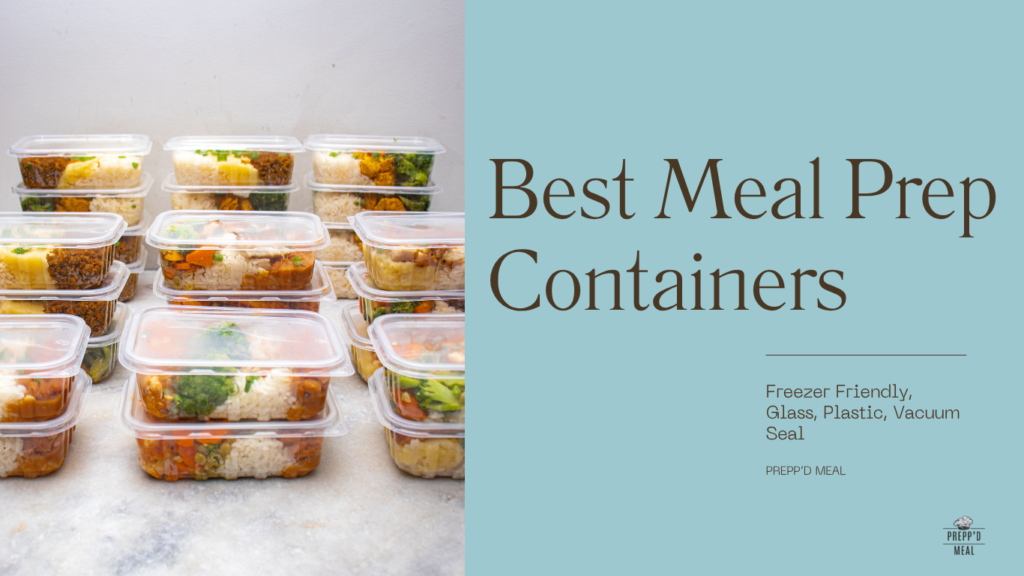
3 Best Meal Prep Containers – Freezer Friendly, Glass, Plastic
You’ve made your meal prep food or planning to in the future.
But you don’t know how to store it.
The container you choose is far more important than you may think.
The best meal prep containers for you will depend on a few factors.
These factors include:
- Space Saving – How much precious space do the containers take up?
- Length of time in freezer – Some container keep food better in the freezer. USDA provides fantastic guidelines and tips on safely freezing food.
- Reheating – How many ways can the container be used to reheat the food?
- Initial cost – How much do the containers cost upfront?
- Recurring cost – Do you have to keep repurchasing the containers because they’re non-reusable?
Keep reading to learn more about the best meal prep containers
What Are the Best Meal Prep Containers?
Are you looking to save money on food costs?
One simple meal prep accessory can be the thing that leads to long term saving.
One of the meal prep containers in this list could be the one that makes all the difference.
The meal prep container you use for your food depends on how you plan to store and reheat the food.
Using the best freezer containers will allow you to keep your food longer.
Plastic tupperware and disposable food trays can work as well, but are more suited for storage in the refrigerator.
If you’re unsure what food you want to make or how you want to store your food, checkout out our guide on how to meal prep.
These are the best meal prep containers to help you start saving now.
1. M Micro Glass Containers
The M Micro glass storage containers come in a set of 8 so you have plenty to store your meals.
These containers are air tight and include latches to keep the lid snug.
These are ideal freezer meal prep containers, but are perfect for the refrigerator also.
Additionally, they allow you to reheat your food in both the microwave and the oven.
Aside from the functionality of these containers, they also look great and make your food look even more appetizing.
Key Benefits
- Latchable lids
- BPA Free
- Freezer friendly
- Microwave safe
- Oven friendly
- Dishwasher safe
- Set of 8
Product Pros
Product Cons
Initial Cost and Recurring Cost
These glass containers will have a higher initial cost than plastic or bags.
They’ll be more sturdy and less likely to crack from general everyday use.
Since they’ll be less likely to crack than plastic, you’ll likely need to repurchase these as often.
Length of Time in Freezer
Glass will not be as good as vacuum seal bags in terms of preserving food in the freezer.
However, having the locking airtight lid helps.
Space Saving
The glass containers will take up a lot of space in the freezer.
That’s precious real estate for you scrumptious meals.
Vacuum seal bags will be the most space saving.
Reheating
Glass is the most versatile when it comes to reheating.
Of course, it has to be oven-safe and tempered glass.
Always confirm this before
Reheating options are:
- Oven
- Always be sure the containers are oven-safe and tempered glass
- Microwave
- Workday Lunch – Grab a container of food out of the freezer and stick it in your bag. By the time lunch comes around it will have thawed and is ready for the microwave.
- Always confirm it is microwave safe
- Stove Top
- Take the food out of the container and reheat on the stove using a pot or pan.
- You may need to add additional moisture to help the cooking process and prevent the food from drying out.
- Air Fryer
- Always be sure the containers are oven-safe and tempered glass
2. Rubbermaid Brilliance Tritan Plastic
Rubbermaid is a well established company that provides quality products.
This set of 10 BPA Free containers includes lids that latch for an airtight seal.
They have built in vents for convenient reheating in the microwave.
These are also freezer and dishwasher safe.
Key Benefits
- Leak proof
- More containers for same cost of glass containers
- Stackable
- Microwave safe
- Freezer friendly
- Multiple size and quantity options
- BPA Free
- Visually appealing
Product Pros
Product Cons
Initial Cost and Recurring Cost
These plastic Rubbermaid containers are going to be about the same initial cost as the glass containers.
However, you’ll get more containers for that cost.
These plastic containers are sturdy, but won’t be as sturdy as the glass so you might have recurring costs sooner.
The recurring costs won’t be as much as the vacuum seal bags and paper containers.
We’ll talk about those containers later.
Length of Time in Freezer
Similar to the glass, these plastic meal prep containers will not be as good as vacuum seal bags in terms of preserving food in the freezer.
Again, having the locking airtight lid helps.
Space Saving
These Rubbermaid containers will take up a similar amount of space as he glass.
Again, taking up precious space in your freezer.
For more space saving, checkout the vacuum seal bags.
Reheating
The plastic containers are not as versatile as the glass.
You’ll want to avoid using these plastic containers in the oven and air fryer.
If you really need to use these to reheat your food, remove the food from the containers first.
Reheating options are:
- Microwave
- Workday Lunch – Works similar to the glass containers. Put one in your bag and it will be thawed by lunch time.
- Always confirm it is microwave safe
3. Syntus Vacuum Seal Bags
Vacuum seal bags are a fantastic freezer meal prep container.
To reheat simple place the bag in boiling water.
You can also take the content of the food out of the bag and cook on stove top or in oven.
These Syntus bags come in a large roll.
The roll includes a build in cutter to make it easy to make bags the exact size you want.
These bags also allow you to save space in your freezer in contrast to glass and plastic containers
Key Benefits
- Large roll
- Built-in cutter
- Dynamic reheating options
- Space saving
Product Pros
Product Cons
Initial Cost and Recurring Cost
The reusable vacuum seal bags have a relatively low initial cost.
The recurring costs will be much higher.
The large rolls will last a long time, but you’ll definitely buy these far more often than the glass and plastic containers.
Length of Time in Freezer
Since the vacuum seal bags take out most the air from the bag, your food will last the longest.
This is partially because there will be less ice forming on your food.
Space Saving
The vacuum seal meal prep bags are one of the most space saving containers.
There isn’t much wasted space.
Having trays to store the frozen bags in will help prevent them from sliding around in the freezer.
Reheating
The reheating of the vacuum seal bags is a bit less convenient.
Unless you have a pot or large pan of boiling water, you’ll have to remove the food from the bag.
This is the case for baking in the oven, air frying, and microwaving.
Reheating options are:
- Boiling Water
- Make sure the pot or pan is large enough to fit the whole bag. Place the bag in the boiling water. Boil for about 5 minutes beyond the point it has completely thawed.
- Sous Vide
- A sous vide can be a convenient way to reheat your meal. Simply set the temperature and allow the water to do the rest.
What Are Meal Prep Containers?
Meal prep containers are used to store meals for the week.
These containers can be plastic, glass, or even disposable paper.
The idea is to make your meals for the week all at once so you don’t have to do any cooking during the work week.
These containers usually have latchable lids to keep it airtight and leak free.
Additionally, they will be microwave safe, freezer safe, and dishwasher safe.
How Can Meal Prep Containers Benefit You?
Meal prep containers can benefit you by allowing you to store your left-overs in the freezer.
This will reduce waste from food spoiling in the fridge.
They also allow you to cook large batches of food for your work week.
This can save you time and money knowing you have food at home ready to eat.
You can buy food in bulk to save money and avoid eating out.
Buyers Guide: How We Conducted Our Research
When doing our research to find the best product, we determined using these factors:
- Pricing: How much did each product cost
- Personal use: Have we had experience with these products?
- Features: What were the best features of each product?
- Negatives: What was missing from each product
- Reviews: We look for many reviews and high rating.
Conclusion
From our experience, these containers are the ones to get.
Which ones you go with ultimately depends on how you plan to use them.
If you have plenty of space in your freezer, glass or plastic containers can be a great options.
If you want to reheat your meals in the oven, the glass containers are the way to go.
If you want to save space in your freezer and keep your food fresh longest, use the vacuum seal bags.
FAQ
Frequently asked questions about meal prep containers